6 Facts You Probably Don't Know About Sipadan
Before it became one of the world's best-known dive sites, Sipadan was a bird sanctuary, an egg-collecting ground, and the subject of an international court case.
Anyone even moderately interested in diving will inevitably hear of Sipadan, a near-legendary island off the east coast of Malaysian Borneo, formed by a reef growing atop an extinct volcano that rises 600m from the ocean floor.
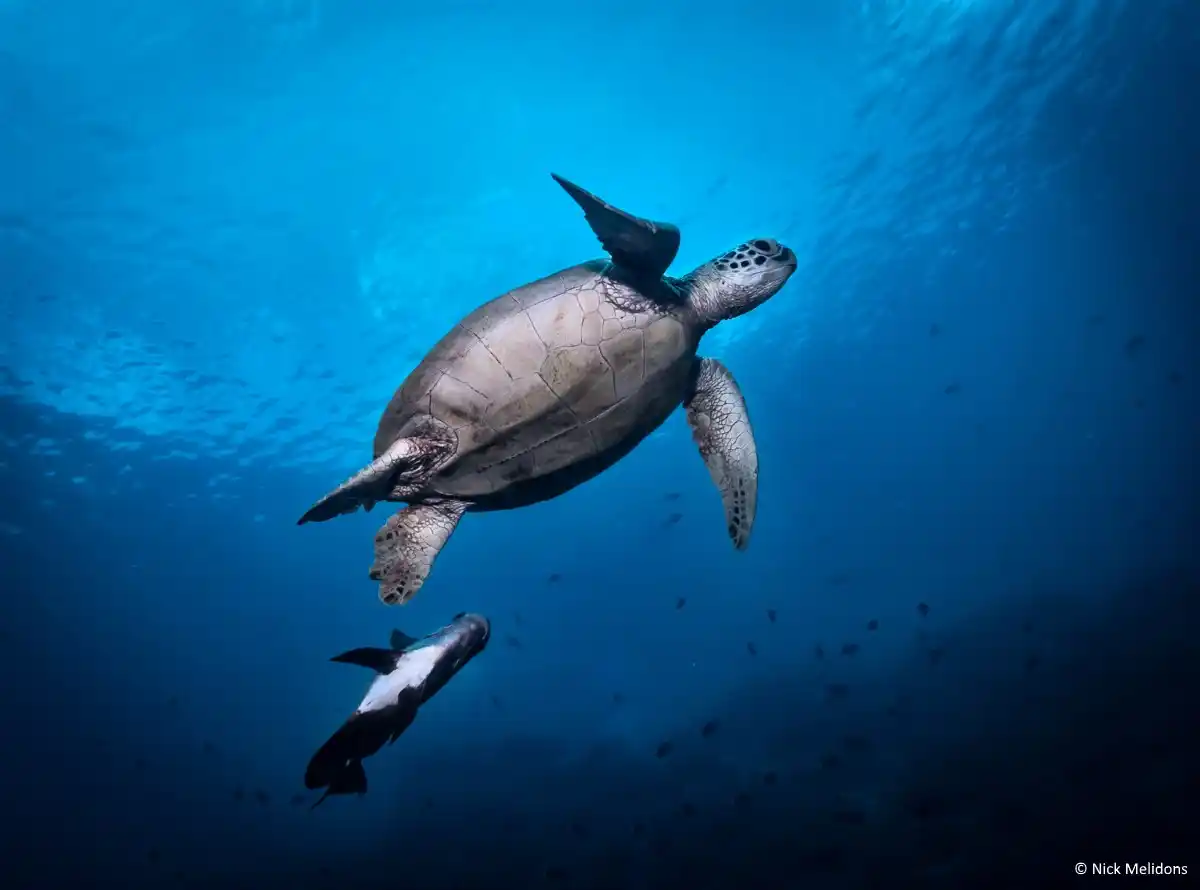
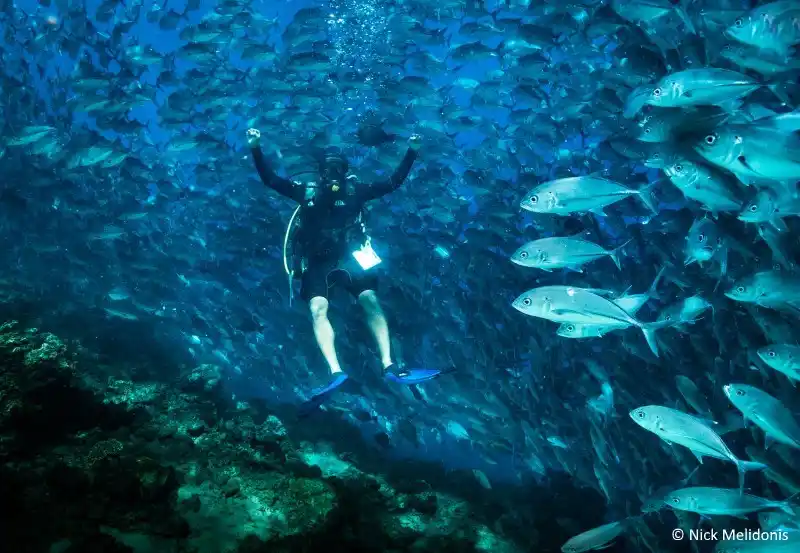
Over the past few decades, it has become one of the world's top dive sites, and arguably the best in Southeast Asia. Among divers, it's known for dense schools of barracuda, large pelagics such as scalloped hammerheads, mantas and eagle rays, and one of the highest concentrations of green and hawksbill turtles anywhere.
But this small, unassuming spit of land has a chequered history stretching back long before divers ever arrived. Here are six things you probably didn't know about this remote stretch of reef.
1. How the Island Got Its Name
Like a lot of place names, the origins of Sipadan's have been muddied by time. You'll sometimes read that Pulau Sipadan (pulau being the Malay and Indonesian word for island) means “border island,” and this would make sense: Sipadan sits roughly where Indonesian Kalimantan meets Malaysian Sabah, and where the old British and Dutch colonial territories once met too. But the Malay word for border is actually sempadan, so this theory doesn't quite hold up.
A more credible suggestion is that the name comes from the Siparan people, part of the local Bajau ethnic group who travelled to the island to harvest turtle eggs. Sipadan is still called Siparan in the Bajau language, which lends the theory some weight.
The most popular version, and certainly the grisliest, holds that the island was named after si Paran, an egg collector whose body was found there long ago. The prefix si is an honorific in Malay, used to show respect or affection, and the island became known as Pulau si Paran, “si Paran's island,” which over time became Pulau Sipadan.

Whichever version is true, the island has been called Sipadan since at least the 1840s, based on the earliest maps that use the name.
2. A Bird Sanctuary Before a Divers' Playground
Despite the turtles nesting on its beaches and swimming offshore, Sipadan was first recognised for its birdlife, not its reefs.
In late 1932, during the colonial period, the Conservator of Forests of Sandakan proposed a bird sanctuary on the island. It was confirmed in the Official Gazette on 1 February 1933, protecting the megapodes, large mound-building birds, that nested there, and was re-gazetted by the Malaysian government in 1963.
The island's status as primarily a bird sanctuary held until the 1970s, when scientists began exploring beneath the waves and realised what they'd found: one of the most significant marine habitats in the Indo-Pacific.
3. The Lighthouse of Sipadan
Sipadan itself is only around 12 hectares. Since the resorts that once stood on the island were demolished, very few structures remain. From the air, one of the more distinctive is a disused 24m lighthouse, though most divers never notice it, since foliage now covers most of it.
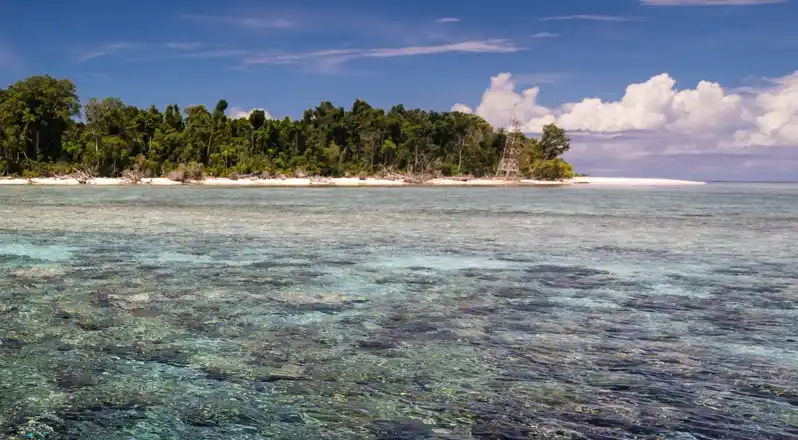
Weathered and largely forgotten today, the lighthouse played a small but real part in one of the more contentious episodes in Sipadan's history. For years, Malaysia and Indonesia disputed ownership of the island. The matter came to a head around 1990, when Indonesia noticed Malaysia constructing tourist infrastructure there, and it was eventually referred to the International Court of Justice in The Hague.
The court ruled in Malaysia's favour, citing the lighthouse's existence as evidence of Malaysia's “effective occupation” of the island. It wasn't the deciding factor in the case, but it played its part.
4. A Dispute Over Turtle Eggs
Another long-running dispute concerned the right to collect turtle eggs on the island. In local culture, turtle eggs carry particular significance, traditionally eaten at weddings and religious ceremonies as well as serving as a source of protein. As a popular nesting site, remote Sipadan became a sought-after location for egg harvesting.
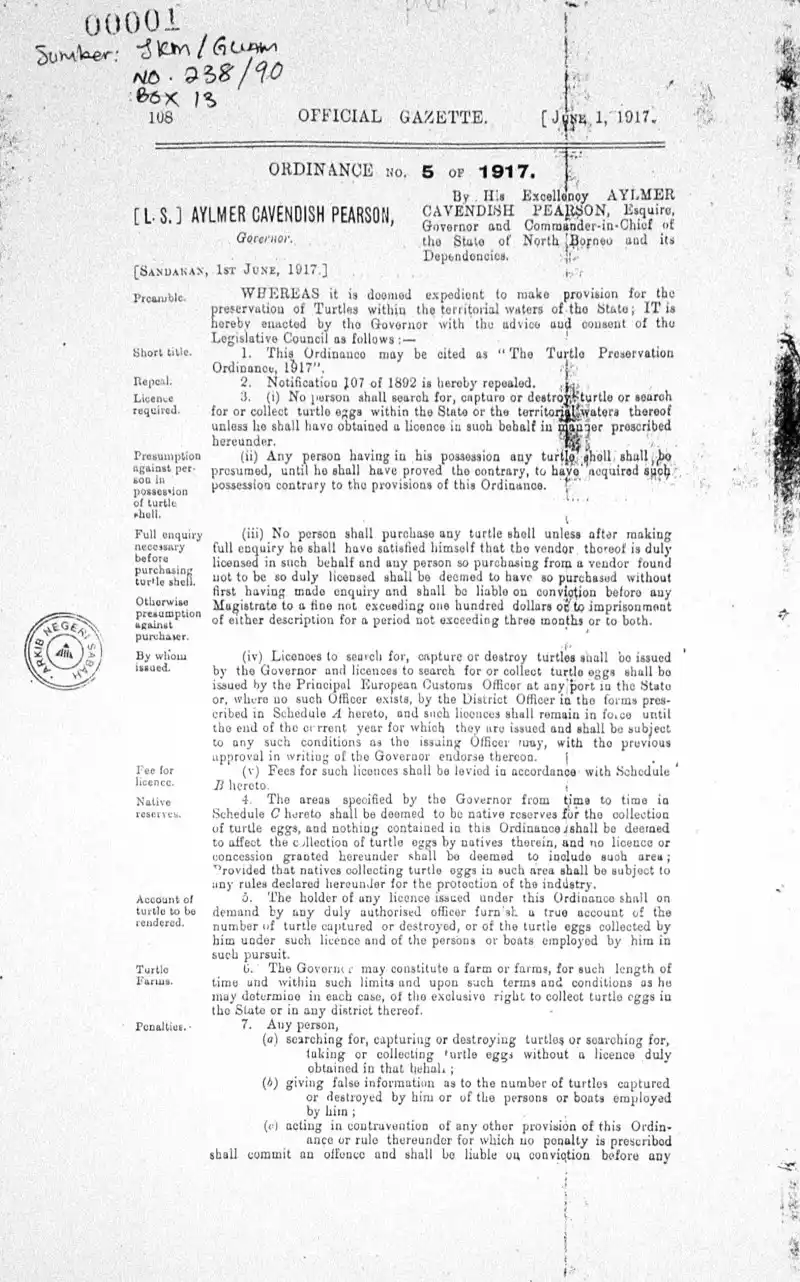
108 OFFICIAL GAZETTE. [JUNE 1, 1917.
ORDINANCE NO. 5 OF 1917.
[L.S.] AYLMER CAVENDISH PEARSON, Governor.
By H's Excellency AYLMER CAVENDINH PEARSON, Esquire, Governor and Commander-in-Chief of the State of North Borneo and its Dependencies.
[SANDANAN, 1ST JUNE, 1917]
Preamble.
WHEREAS it is deemed expedient to make provision for the preservation of Turtles within the territorial waters of the State; IT is hereby enacted by the Governor with the advice and consent of the Legislative Council as follows:-
Short title.
- This Ordinance may be cited as “The Turtle Preservation Ordinance, 1917”.
Repeal.
- Notification 107 of 1892 is hereby repealed.
Licence required.
- (i) No person shall search for, capture or destroy turtle or search for or collect turtle eggs within the State or the territorial waters thereof unless he shall have obtained a licence in such behalf in manner prescribed hereunder.
Presumption against person in possession of turtle shell.
(ii) Any person having in his possession any turtle shell shall be presumed, until he shall have proved the contrary, to have acquired such possession contrary to the provisions of this Ordinance.
Full enquiry necessary before purchasing turtle shell. Otherwise presumption against purchaser.
(iii) No person shall purchase any turtle shell unless after making full enquiry he shall have satisfied himself that the vender thereof is duly licensed in such behalf and any person so purchasing from a vendor found not to be so duly licensed shall be deemed to have so purchased without first having made enquiry and shall be liable on conviction before any Magistrate to a fine not exceeding one hundred dallars or to imprisonment of either description for a period not exceeding three months or to both.
By whom issued.
(iv) Licences to search for, capture or destroy turtles shall be issued by the Governor and licences to search for or collect turtle eggs shall be issued by the Principal European Customs Officer at any port to the State or, where no such Officer exists, by the District Officer in the forms prescribed in Schedula A hereto, and such licences shall remain in force until the end of the current year for which they are issued and shall be subject to any such conditions as the issuing Officer may, with the previous approval in writing of the Governor endorse thereon.
Fee for licence.
(v) Fees for such licences shall be levied in accordance with Schedule B hereto.
Native reserves.
- The areas specified by the Governor from time to time in Schedule C hereto shall be deemed to be native reserves for the collection of turtle eggs, and nothing contained in this Ordinance shall be deemed to affect the collection of turtle eggs by natives therein, and no licence or concession granted hereunder shall be deemed to include auch area; Provided that natives collecting turtle eggs in such area shall be subject to any rules declared hereunder for the protection of the industry.
Account of turtle to be rendered.
- The holder of any licence issued under this Ordinance shall on demand by any duly authorised officer furnish a true account of the number of turtle captured or destroyed, or of the turtle eggs collected by him under such licence and of the persons or boats employed by him in such pursuit.
Turtle Farms.
- The Governor may constitute a farm or farms, for euch length of time and within such limits and upon such terms and conditions as he may determine in each case, of the exclusive right to collect turtle eggs in the State or in any district thereof.
Penalties.
- Any person, (a) searching for, capturing or destroying turtles or searching for, taking or collecting turtle eggs without a licence duly obtained in that behalf; (b) giving false information as to the number of turtles captured or destroyed by him or of the persons or boats employed by him; (c) acting in contravention of any other provision of this Ordinance or rule thereunder for which on penalty is prescribed shall commit an offence and shall be liable on conviction before any
In 1878, the Sultan of Sulu granted two families the perpetual right to collect eggs from Sipadan, in exchange for a licence fee paid as a share of the eggs collected. The right passed down through generations, and the families were still collecting eggs there into the 1980s.
By then, a handful of pioneering dive operators had already begun bringing divers to Sipadan's now-famous waters. To protect the island's environment and its seasonal turtle visitors, the operators agreed to pay the families an annual sum in exchange for ending the egg harvest.
That arrangement held until the late 1980s, when the Sabah government granted licences to twelve businesses to build tourist facilities on the island. Worried about missing out on the tourism revenue, representatives of the two families took the matter to court, reasserting their right to collect eggs and laying claim to the island itself.
After a lengthy court battle, the ruling went against the families. Turtles have laid their eggs on the island free from human collection ever since.
5. The Turtle Hatchery on Sipadan
Sabah's better-known Turtle Islands Park, made up of three islands, is where most visitors learn about local sea turtle conservation. Fewer people know that Sipadan runs its own hatchery, one that doesn't promote itself the way Turtle Islands Park does.
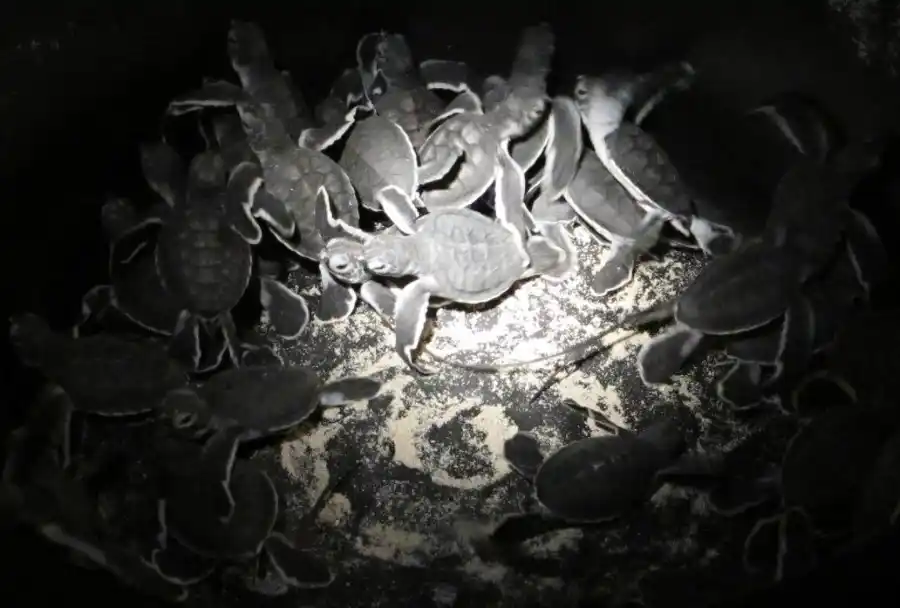
A dive or snorkel permit doesn't give you access to the hatchery; visiting requires contacting it directly to arrange a tour. Located around 150m from the jetty, it collects eggs laid on the beaches and moves them to a protected area, safe from birds and rats.
Half the eggs are incubated in shade and half in full sun, since temperature determines the sex of the hatchlings, with warmer conditions producing more males. Hatchlings are released four metres up the beach rather than directly into the sea, which is thought to help them imprint on the island for their eventual return as adults.
6. How Sipadan Became a World-Renowned Diving Spot
Sipadan's rise to one of the world's best-known dive sites is closely tied to French explorer Jacques Cousteau, though he was far from the first person to visit.
Cousteau initially came looking for a mythical “scarlet octopus” said to protect the islands. After a few dives, though, he and his team recognised the richness of what they'd found, including an underwater mystery: a cave system holding the remains of countless drowned turtles, later named Turtle Tomb. The story became the subject of his documentary, Bornéo: Le spectre de la tortue (Borneo: The Ghost of the Sea Turtle).
Impressed by what he'd seen, Cousteau later remarked, “I have seen other places like Sipadan, 45 years ago, but now no more. Now we have found an untouched piece of art.”
Between the quote and the footage of divers exploring Sipadan's caves, the world's diving community took notice, and Sipadan was on its way to becoming one of the most revered dive sites on the planet.
Looking to the Future
Over the years, Sipadan has weathered tropical storms and sat at the centre of several controversies.
Pressure on the site hasn't disappeared. Even with daily divers capped at 252 permits, issued by Sabah Parks, the reef remains under strain, and diving tours running out of Semporna add to pollution levels on the mainland side.
For now, the ban on new development is holding, and the long-term goal of UNESCO recognition remains a real possibility. Managed responsibly, this stretch of reef should stay one of the more coveted entries in any diver's logbook for years to come.
The State Government of Sabah has gazetted Sipadan as a park since 2009, covering an area of 16,845.5 hectares.